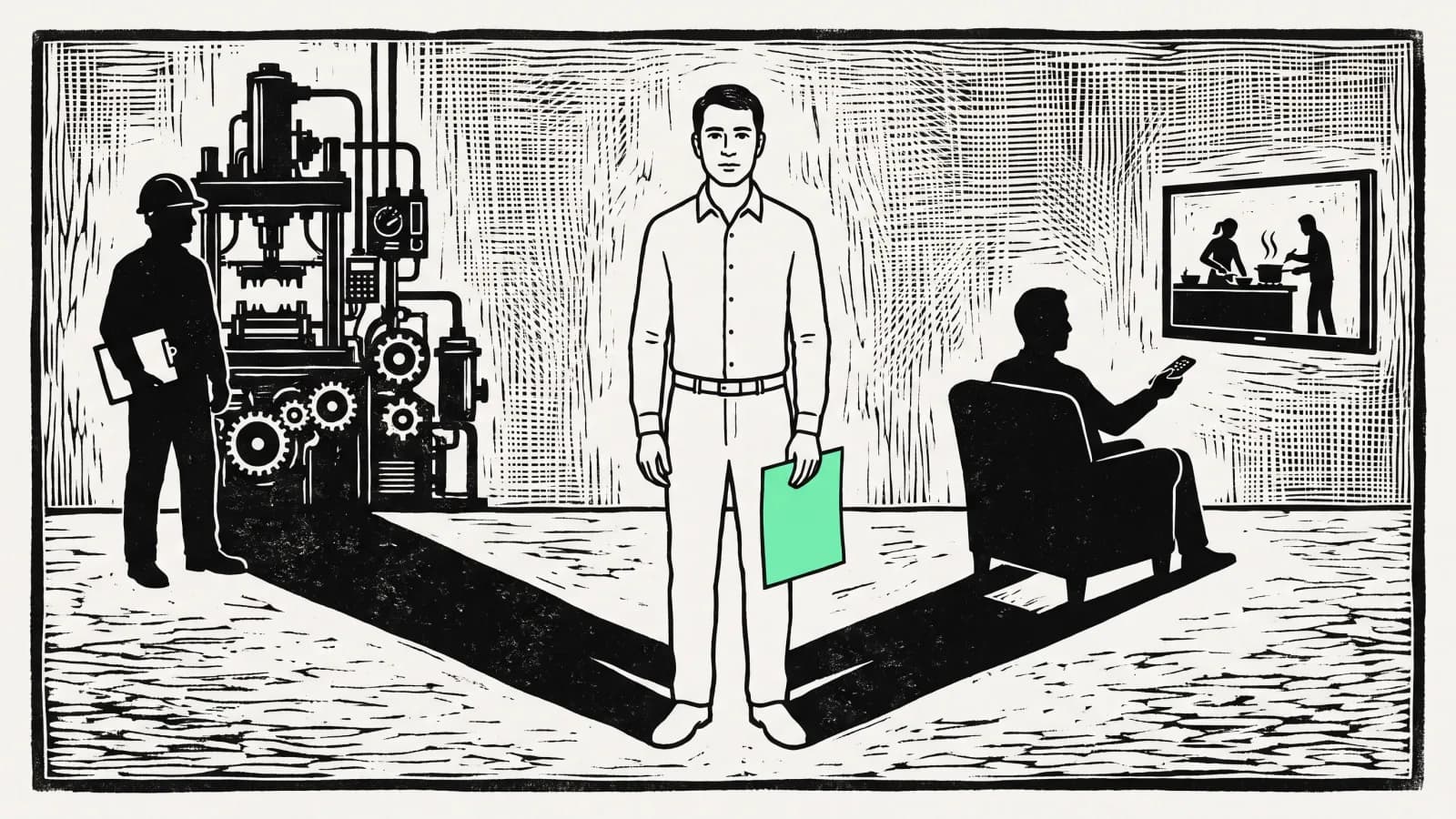

Four jobs nobody told me about
Yet I have never worked so much. The time saved on execution went into four jobs:
- Technician: everything that runs has to be hosted, secured, paid for and updated.
- Tutor: you have to train your agents, your internal team, the client, and start again at every update.
- Guardian of the craft: the more AI acts alone, the more an error of judgement can cost, and it will be your responsibility.
- Manager: you delegate, you check and you correct agents like a team.
Being an agentic manager is first of all being a manager: delegating to AI agents as you would to a team of humans, and answering for them in the same way, with time, patience and upkeep.
If I had to sum it up, I see seven levels to reach agentic manager. Each level earned me something (time, performance…) and, in parallel, loaded me with other responsibilities.
The seven levels at a glance
Level | What the AI does alone |
|---|---|
1. The Chat Insomniac | Nothing, it answers |
2. Sunday Elon | It reads your tools |
3. The Proud Geek | It applies your method |
4. The Ex-localhost | It runs with the computer closed |
5. The Ambassador | It serves the whole team |
6. The Diplomat | It picks up any file |
7. The Parent of Agents | Almost everything |

Level 1 · The Chat Insomniac
Understanding context
Late 2022, hyped like never before, I sign up to the waiting list to test ChatGPT early. I get going fast: challenging a strategy, rewording a delicate email, reading a screenshot of a campaign.
The models are not amazing yet, but the serious upgrades are coming, and I follow them all. Claude arrives on the market with new interfaces, notably Cowork (Claude's workspace), the projects where you store your documents and your instructions. You leave the phase of simple exchange and start your first deliverables: a Word document, an Excel sheet, a PowerPoint deck.
This level teaches you one thing above all: everything hinges on context. The more the AI knows who you are, what you sell and how you work, the better the answer.
The gain: a consultant available at midnight, who never tires of rewording.
The bill: nothing runs, so nothing to maintain. In exchange, you copy everything by hand, and the context you wrote ages as soon as your business moves.

Level 2 · Sunday Elon
Plugging in your first tools
You plug in your first MCP, a connector that lets the AI read your mailbox with your permissions. It finds a client email that fell into spam, sums up a week of exchanges. Usually, this is the stage where you lose it and take yourself for the next Elon Musk. You plug in a second one, then the calendar, Drive, Meta Ads. It is madness.
It is also where you move to the higher subscription, and set up one profile per specialty, or per client if you work in an agency.
The comedown arrives when you step back and look at what you made. Same disappointment as the Cybertruck window shattering in front of the whole room during the launch: it is not as well done as if you had done it yourself. The connector can read and understand, but it quickly hits technical limits for truly professional work.
The (co)work environment has reached its limits, you want to go further, but MCPs will not let you. Welcome to the new gate: you have to switch to Claude Code or Codex.
The gain: the AI fetches answers from your tools, no longer only from your memory or your notes.
The bill: accounts, permissions, connectors that break without warning, and usually more subscriptions.

Level 3 · The Proud Geek
Adding your expertise
MCPs are nice, but generic. You take your courage in both hands and dive into the more technical part, with lines of code you do not master, but every YouTube tutorial says you must.
You start by creating your projects (again, since they cannot be transferred). Then come the first times:
- skills, procedures the AI loads when a task calls for them;
- workflows, with scheduled tasks;
- your first web pages or online artifacts;
- APIs, the technical front door of a piece of software, when the connector is no longer enough;
- OAuth access, the system that authorises a tool to act on your behalf;
- CLIs, those tools you drive from the command line.
You realise your previous level was poor, you step back and truly understand that you can build custom. You get a little carried away, and usually at that point you launch your first project. You will soon see it is too big: you started on an evening of enthusiasm, and that project will never really see the light of day. It is part of the level: you learn to cut things up, to ship small, to drop what will not hold.
This is the stage where you have to become a project manager: feeding a roadmap, keeping a journal, improving your procedures and your skills. A real job. I was lucky to get past this level thanks to a background that already existed: years of managing web and e-commerce projects, complete acquisition strategies, and a proud geek side. AI sped up what I already knew how to read or do.
The gain: the AI finally works like you.
The bill: the technician enters your life. Code to understand, API keys that expire, access to administer, a written method to keep up to date.

Level 4 · The Ex-localhost
Going to production
Until now, everything ran on localhost, that server which only exists on your computer: it works for you, and for nobody else. It is time to build a real stack, the set of building blocks that keep your tool alive somewhere other than on your machine.
So you start challenging every tool in your stack, looking for the best one, wondering whether you should stay on WordPress or go custom. You discover tools that ship to production fast: Vercel, Neon, Supabase…
For the most motivated, this is when you start telling yourself that your LLM only works if your computer is open. You look for solutions, you start putting conversations in the cloud.
You ship your first project to production. From now on, colleagues, clients and candidates depend on what runs at night, without you in front of the screen.
The gain: it runs at night, and it finally runs without you.
The bill: monitoring and improvement. Your clients or your team members understand that you can do almost anything, requests explode, but you have to keep watch: nothing must break in silence. You go through the logs and the hosting bills. The technician becomes a part-time job.
Level 5 · The Ambassador
Bringing the team on board
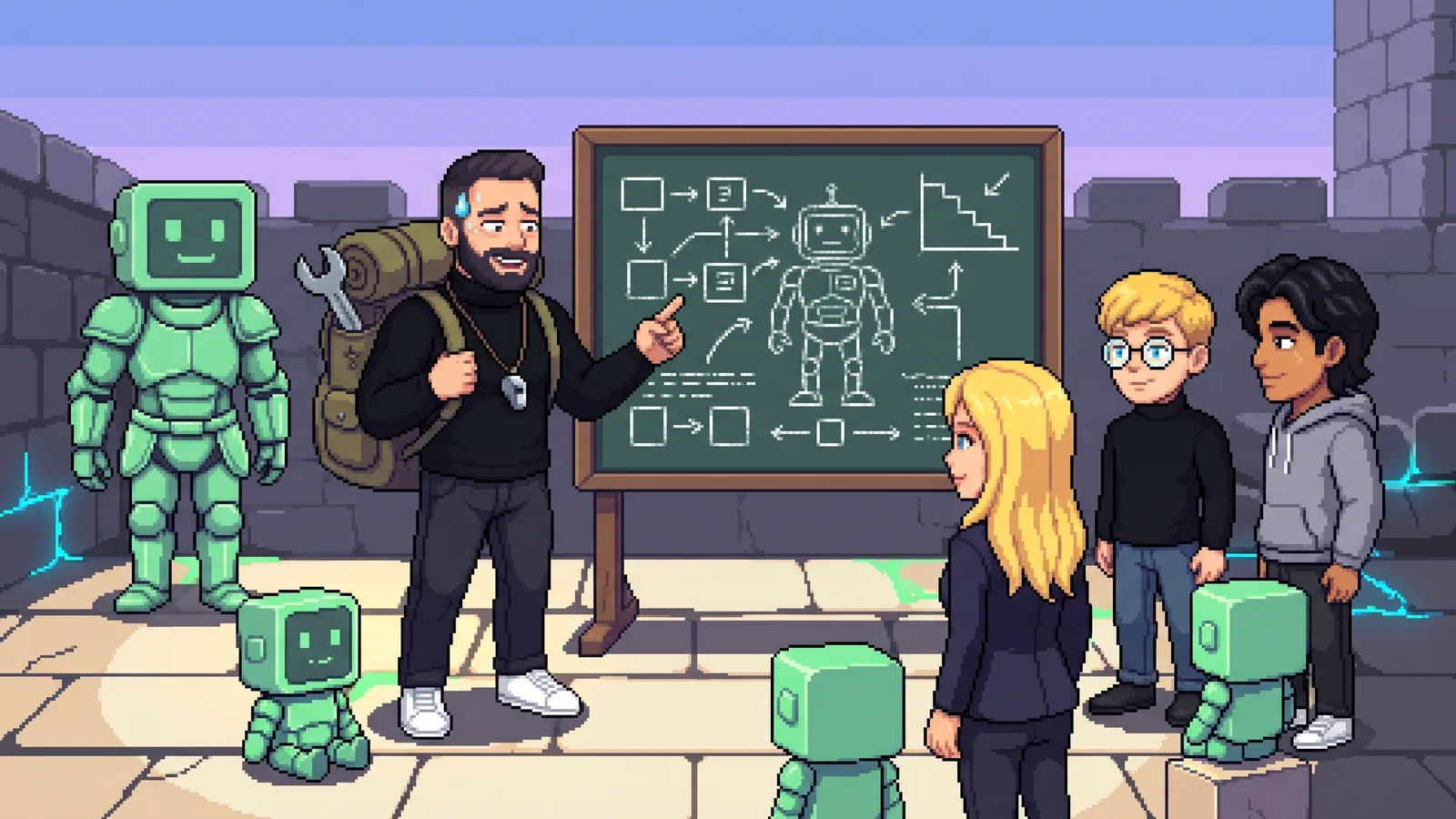
First real challenge. As long as everything depends on your stack, your knowledge, your keys and your account, the team only has a shortcut to you. You have to open up access, share the code, work in branches (working copies that you merge afterwards) so everyone moves forward without breaking the others' work. Hello GitHub.
The context becomes shared: you have to explain to them how you built things and why. They do not use AI the way you do, they have a different experience. They challenge your method, your reasoning, your way of working.
Who is wrong, who is right? AI does not decide, that is your role. You also have to understand who really has the capacity to come on board with you on the projects, and work out where each team member stands.
Then, once the profiles are chosen, you train, and you untrain too. Updates move so fast that what you show one month will not work the same way the next.
A concrete example: on 30 March, I trained 40 people on Claude. If I had to give that training again tomorrow, I could throw 90% of it in the bin.
The gain: the stack serves four people instead of one, each at their level, and everyone grows in skills.
The bill: the tutor. Training, retraining, arbitrating the shared context, and accepting that everything you teach goes stale within weeks.

Level 6 · The Diplomat
Bringing clients on board
Your client sees what comes out of your stack and asks how you do it. They are at level 1, level 2 if you are lucky. You cannot copy your stack over to them: they have neither your access, nor your context, nor your skills, and they are far from being a technician. You bring them on board at their level. You show them what the AI did, what it did not do, and why every output gets proofread before it is believed. You know a stack is a custom project: it will not work properly if the client does not follow the whole process.
But you have no choice: your clients have to enter your stack to bring business knowledge. So you build your first shared dynamic contexts, either with a RAG or with a database tool like Notion.
You quickly understand that for an agent to perform, it must pick up a perfect context file, fed by your team and by your client. You have to document the internal processes:
- who invoices;
- who decides;
- which tools and which access;
- which rules.
That is when you discover that the identity of things is written down nowhere.
The context really has to live and be shared: an acquired company changes its name, a subsidiary has to be separated from its parent, the client you invoice is not always the one you serve, and you need to know what is still an idea, a planned campaign or a campaign in production.
The gain: any file can be picked up, by an agent or by a colleague, without calling you.
The bill: the guardian of the craft. Everything a client sees coming out of your stack, you must be able to defend, figure by figure, definition by definition. An AI mistake at the client's is your signature underneath.

Level 7 · The Parent of Agents
Raising your own agent
At last, here we are. You master every step, you have understood everything at stake with AI in production. You are ready to become a parent, and I have no other word, literally as much as figuratively.
You are raising a baby that knows everything, and nothing at the same time.
In my case, it is Hermes, the open source agent from Nous Research, installed on our own VPS, with a main agent connected around the clock, in a co-manager role.
You start over from the beginning and document the life of your company: clients, rules, decisions, mistakes. You plug in a smart memory (an Obsidian vault, for example), fed continuously, which the agent consults before each answer (a RAG), and which mixes the archive, the work in progress and what remains to be produced.
Three months later, you have a co-CEO steering three specialised profiles: one that manages client files and their contexts, an autonomous project manager that feeds tasks into Notion, and an accounting profile (bookkeeping, standard invoicing).
At first you produce automatically, but you still have to proofread. You steer, you receive notifications to make decisions, because you put guardrails in place.
The day will come when it all lives. Your chartered accountant will ask why you booked that invoice that way in your ERP, or where such and such a mission for such and such a client comes from, and you will be able to be a real manager and say "Hold on, let me check with my team".
You no longer have full control. You have to accept it, and decide where delegation stops. Who knows, was it really me who wrote this article?
The gain: you proofread work you did not do.
The bill: the manager. You no longer maintain tasks, you maintain several agents: their memories, versions, permissions, budgets, and above all the trust you can give them. Every correction you make has to become a rule, otherwise you will make it again next month.
The urge to rebuild everything will come
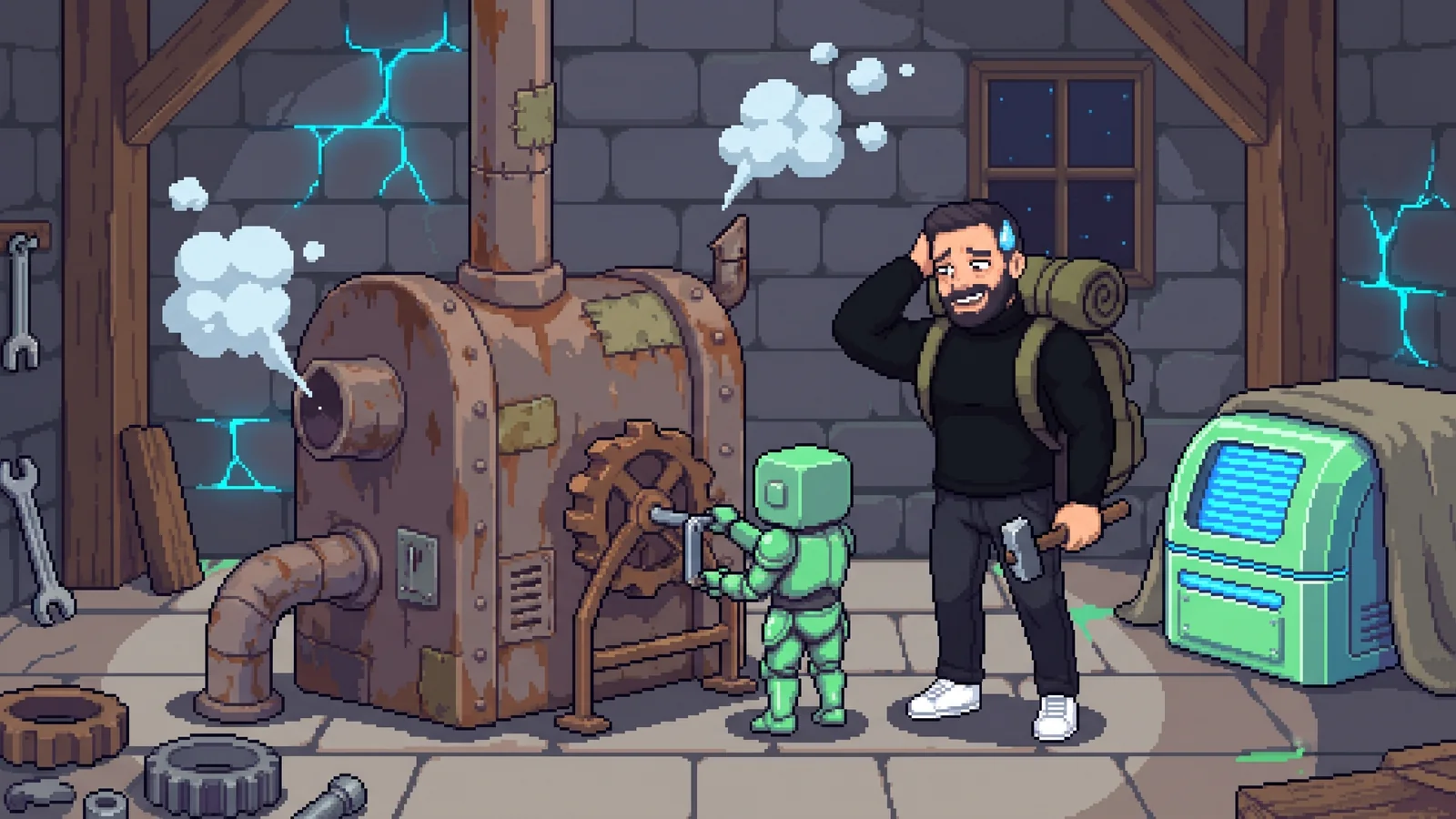
The real trap of a stack is the urge to change everything all the time. Every month brings a new method, a new tool, a better way of doing things. I have n8n agents running. I no longer touch them, because they work. I would not build them that way today, but they work.
Knowing how to leave what works running is part of the job. You rebuild when it breaks or when it costs too much, not because something new just came out.

How far to go alone?
A good prompt takes you to level 2. Beyond that, it is no longer decided in the conversation, but in the way you work, and in what you agree to answer for.
The real limit is not technical, it is responsibility. At each level, ask yourself a single question: if it breaks on a Sunday evening, who answers?
- At level 3, it is you, and you can unplug everything.
- At level 4, your colleagues and your clients suffer the outage with you.
- At level 7, the agent acted without you, and it is still your signature.
If you are starting from scratch, aim for level 3 alone: as long as everything runs on your machine, you are the only one paying for your mistakes. Beyond that, bring in a technician and understand what they build: otherwise you can neither check it nor defend it in front of a client.

But Jérôme, why are you not working less?
AI saves time on execution, and that time goes back into the four jobs. I produce more, on more fronts, with the team and agents that run at night. I do not work less.
On the bill side, to give you an idea of what my Hermes AI stack costs: around 320 dollars a month, not counting the time it takes every week to keep it all running.
Tool | Monthly cost |
|---|---|
ChatGPT | $200 |
DeepSeek | $100 |
Agent server (VPS) | $21 ($250 a year) |
Your soul | A good part of it |
Total | around $320 |
If you want to place your level and see what the next one would ask of you, book a meeting to talk about it.