1 · Art direction and UX design miss the same turn
Too often, Art Direction comes before strategy and the audit. The pattern is well known in agencies: you brief a senior art director. He comes back with a big one-shot creative campaign validated by a subjective jury around a table. The SMB pays hundreds of thousands of euros for that campaign. It ships without having pre-tested the audience. It drops. Six months later, you look at the numbers, and nobody really knows what worked or didn't, because the pre-test never happened.
On the UX side, the pattern is identical. You plan weeks of research, wireframes, Figma prototypes, moderated tests. You validate in a meeting. You deploy. Six weeks later, live data reveals that users click somewhere other than expected and conversion isn't taking off. The strategic brief missed a signal that 2 weeks of live A/B testing would have revealed immediately.
The common pattern: Art Direction > strategy audit, heavily planned UX design > live data. In both cases, gut feeling is placed above data. In both cases, it's the mistake of the moment.
2 · On the creative side: 82% of advertisers have already handed over to Meta's Advantage+ algorithm
The market shifted without many Belgian creative agencies noticing. The figures come straight from Meta and from the 2025 ad-tech ecosystem.
Data point | Value | Source |
|---|---|---|
Advantage+ adoption by advertisers 2025 | 82% | |
Advantage+ ROAS vs manual | +22 to 32% | Meta Q1 2025 earnings |
ROI $ per $ spent Advantage+ | 4.52 $ ROAS on 1 $ spent | Meta Q1 2025 |
Advantage+ CPA vs manual | -26% | Meta |
Incremental conversion lift | +37% vs manual | Meta |
AI bidding vs manual bidding | +27% ROAS | |
AI adaptive variants vs static human-made | +35 to 40% CTR lift in controlled A/B |
Meta Advantage+ Creative automatically combines headlines, images, CTAs and descriptions to produce the best combinations per audience segment. The neural networks analyze CTR, engagement quality, conversion probability, creative fatigue. If your audience gets tired, the algorithm rotates without asking your art director.
It's over, the one-shot hero creative campaign. The market has ruled: creative performance is measured with live data, not by a subjective jury around a table. See the community vs performance article which details the Meta Ads budget math in Belgium.
« 82% of advertisers have caved. What's the point of your traditional creative agency? »
3 · Higgsfield + Pomelli + Pletor: the brutal SMB math
While the algorithm takes power over creative rotation, AI tools are breaking the traditional big-production dynamic. Three concrete examples for SMBs.
Higgsfield AI: the end of the 30,000 EUR fashion lookbook
Higgsfield AI Fashion Factory generates complete photoshoots from a single product image. Photorealistic, ready for PDPs, carousels, ads. The platform integrates Sora 2, Kling 2.6, Veo 3.1, FLUX 2. The tool is a subscription, roughly 15 to 90 EUR per month depending on the plan (Starter to Ultra).
Production | Cost | Lead time |
|---|---|---|
Traditional BE fashion lookbook | 10,000 to 50,000 EUR (crew 3-8k EUR/day + post-prod 2-5k EUR) | 2-6 weeks |
Creative campaign produced with Higgsfield | ~15 to 90 EUR/month subscription + curation time | 1-3 days |
The real cost isn't the tool, which runs a handful of euros per month, it's the time spent briefing, generating and sorting the visuals. For an ambitious clothing e-shop, a lookbook that cost 30,000 EUR as a traditional shoot is redone in-house for a few thousand euros all in (subscription + the time of a well-briefed art director), roughly 10 times cheaper. The math is brutal. The art director hasn't disappeared, they've changed tools. Source: Higgsfield AI Review 2026 by Gaga.
Pomelli: Google Labs gives SMBs assets
Pomelli by Google Labs (launched late 2025 with DeepMind) explicitly targets small-to-medium businesses. The mechanism:
- Brand Analysis: analyzes your website to create a "Business DNA" (tone of voice, custom fonts, images, color palette)
- Campaign Generation: campaign ideas tailored to your business
- Creative Asset Creation: on-brand marketing assets for social, site, ads
Availability: public beta in Europe (EEA, UK, Switzerland) in English. Pricing: free, several hundred image/video generations. Source: Pomelli in Europe, Google Blog.
Honest strategic question: when Google Labs gives SMBs Pomelli for free, what's the point of your traditional creative agency for producing on-brand social assets? The honest answer, in most cases: none.
Pletor + Suno + ElevenLabs: the HeySquad AI creative stack
We already use Pletor on HeySquad missions (see the squad page which lists our stack). On top of that, we demonstrated in the making-of of our 404 game that you can generate an original musical universe with Suno V5 (French hyperpop 140 BPM gameplay + frenchcore 200 BPM boss) and two custom narrative voices with ElevenLabs Voice Lab (verbatim prompts quoted in that article 2). Accessible stack, total spent: 7h of prompt engineering.
4 · On the UX side: long planning has become the bottleneck
The angle doesn't change, just the discipline. According to the 2025 UX Research Trends Report by Askable:
Data point | Value |
|---|---|
Organizations that use research for critical decisions | 87% |
Designers who gather user insights | 70% |
Top UX research issue 2025 | 63% cite time + bandwidth as the main blocker |
Difficulty recruiting participants | 48% |
Struggle to connect research → business outcomes | 42% |
Main 2025 shift | "Time-to-market" → "Time-to-right" |
The report is clear: long UX planning has become the bottleneck. 63% of UX teams aren't complaining about a lack of tools or talent. They're complaining about the time the traditional method takes.
Meanwhile, the tools that let you test with live data are becoming native and free.
5 · Shopify Rollouts + Microsoft Clarity: live data won
Shopify Rollouts: native A/B testing included
Shopify Rollouts lets merchants allocate a percentage of visitors to test variants, directly on the published theme, without creating duplicates. The Advanced plan runs rollouts as experiments with compared metrics: conversion rate, bounce rate, checkout reach, add-to-cart rate.
Official Shopify use cases: scheduled seasonal campaigns, performance comparison, risk mitigation before permanent deployment, customization by market. UX A/B testing has become a native CMS feature. No more need for an extra stack to test whether a new CTA converts better than an old one.
Microsoft Clarity: free heatmaps + session recording
Microsoft Clarity offers free heatmaps + session recordings + a native Shopify dashboard (checkout abandonment, purchases, most viewed products). Documented source: identify a non-clickable zone clicked by mistake via a Clarity heatmap → redesign the CTA → +20-30% conversion uplift in comparable B2B.
It's free. It's native to Shopify for Belgian e-coms. You need a serious reason not to have integrated it into your UX workflow by tomorrow morning.
« Shopify tests natively. Microsoft Clarity is free. What's the point of UX planned for 6 weeks in wireframes? »

6 · The only fix that matters: an integrated A/B testing process
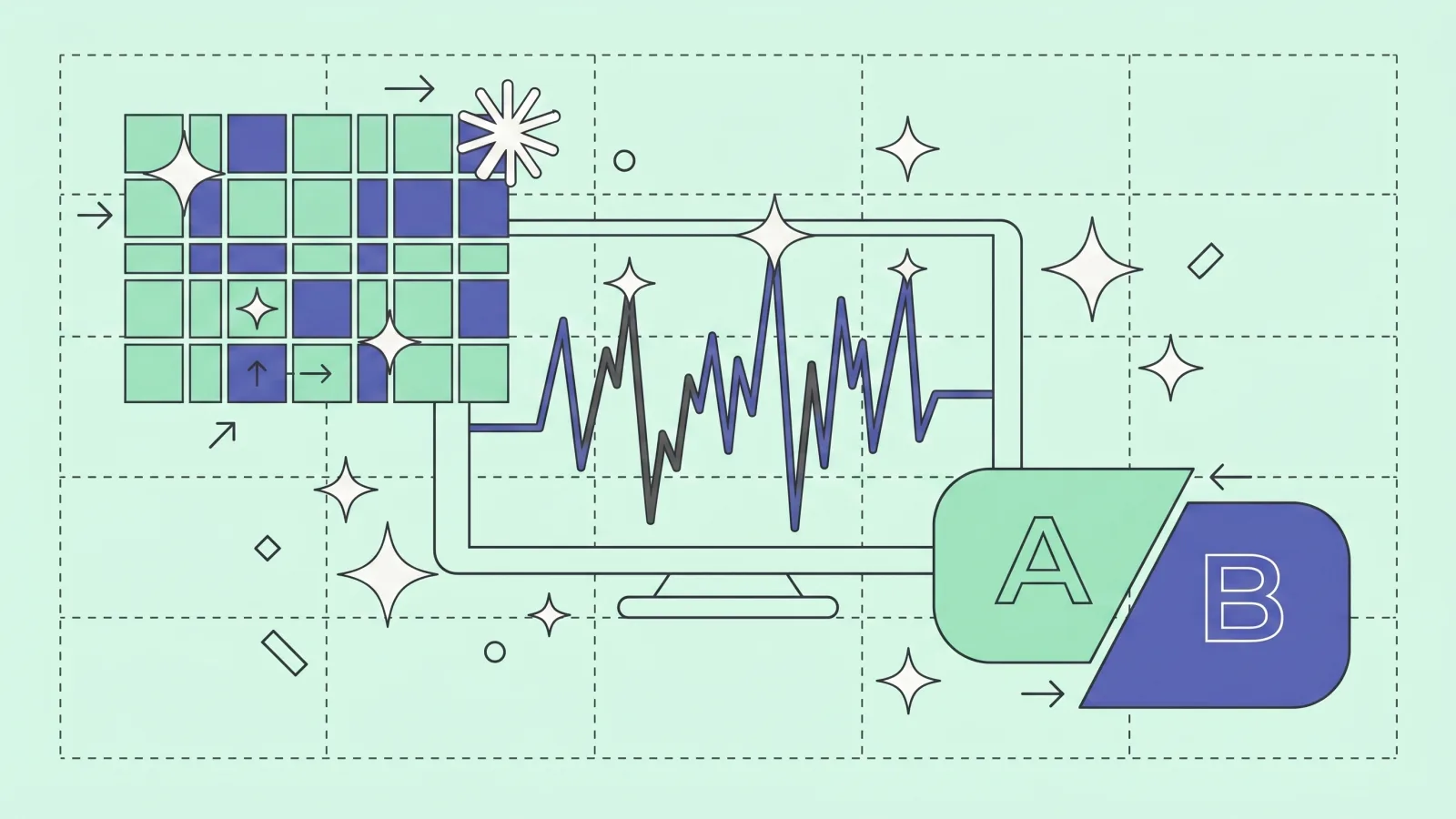
Creative and UX agencies won't die. They need to evolve. Of all the possible fixes, only one really matters: building the A/B testing process into the method.
In concrete terms, that means:
- On the creative side: produce 10 to 20 variants per campaign instead of 2-3 hero pieces. Let Meta Advantage+ and Google PMax rotate. Measure with data, not with a subjective jury.
- On the UX side: ship a testable MVP in 2 weeks instead of 6 weeks of wireframes. Allocate 10% of traffic to a variant via Shopify Rollouts. Decide with data after 2-3 weeks.
The art director and the UX designer keep their place. They just change posture: data-informed advisors instead of sacred art directors. Art direction proposes. The algorithm and the client decide with data.
It's the evolution that separates the agencies that will survive the next 18 months from the ones that won't.
7 · Three cases where traditional art direction + UX remain legitimate
The strong opinion isn't absolute. Three business contexts still justify a big one-shot art-direction campaign or a heavily planned UX design.
1. High-end brand launch (luxury, premium). Luxury codes are built through artistic brand consistency, not CTR A/B testing. Hermès, Rolex, Cartier don't test their next campaign in Meta variants. Art direction stays signature and strategic there.
2. Mass-market brand TV for long-term recall. A TV campaign that runs 6 months in heavy rotation builds mental recall over 2-3 years. Live data has no leverage on that signal. Strong, consistent branding wins.
3. Regulated sector (healthcare, consumer finance, medication). Live A/B testing is legally constrained or forbidden. Every piece of creative and every UX journey must be validated by compliance before deployment. Long planning is imposed by the legal framework, not by methodological preference.
Outside these 3 cases, the "big art-direction campaign" or "6 weeks of planned UX" reflex is the exception, not the norm. The norm for standard B2B and B2C SMBs is live data and rapid iteration.