1 · The persona, the way an agency builds it for you
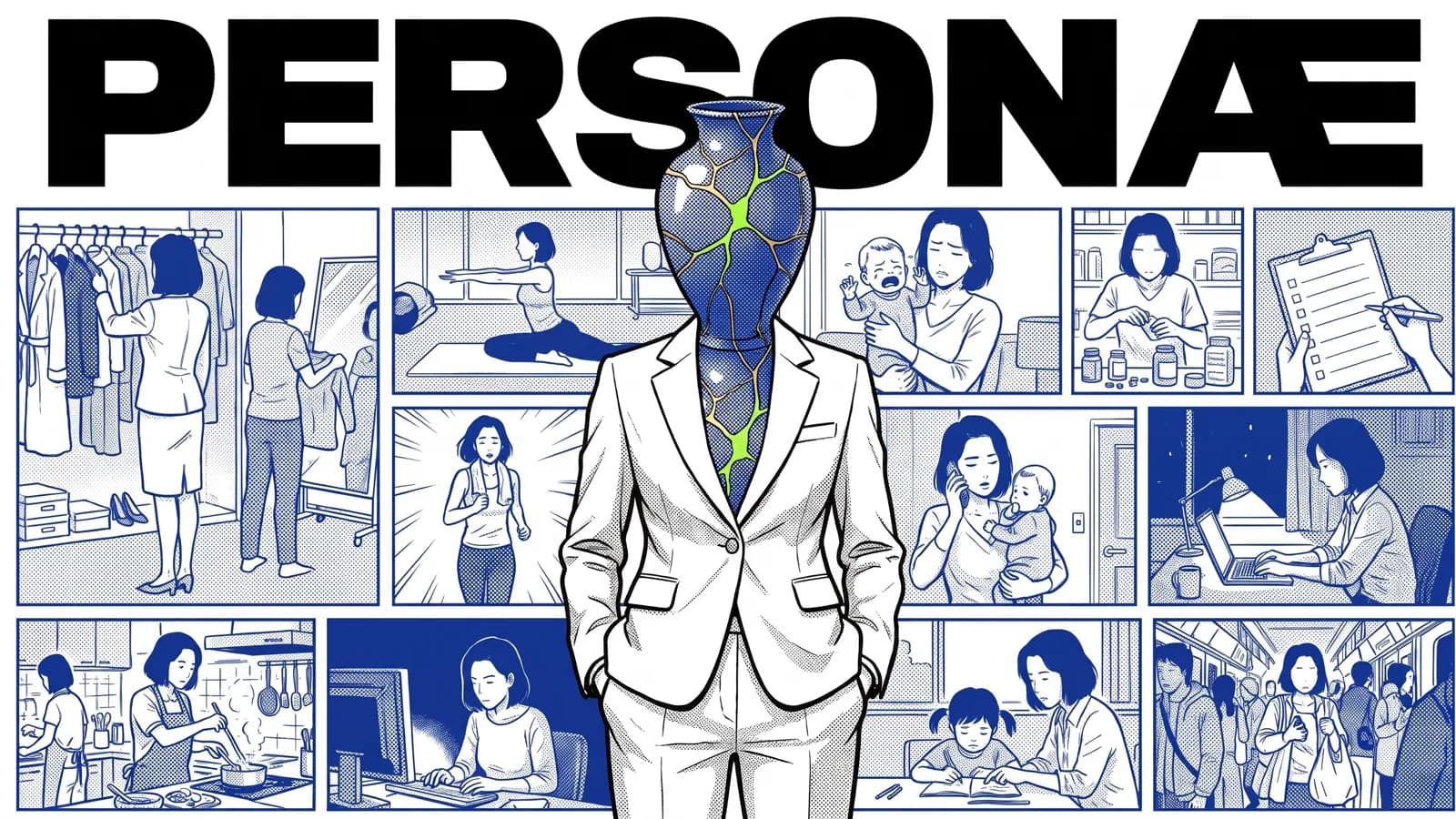
Let's take the classic method again, without caricaturing it, because it has its logic. A branding agency hands you a sheet: first name, photo, age, job, income, goals, frustrations, sample quote, channels, daily routine. The idea is sound: speaking to someone rather than to "a target" in the abstract.
Often, you get three. The primary persona, the core target. The secondary one, who influences the purchase without deciding it, the partner or the manager. The negative one, the profile you want to keep away, because it costs a lot and leaves fast. Three portraits, one workshop, a nice document.
The exercise has real value, and it always will: it aligns a team on who it's talking to. The catch comes right after, in a promise nobody spells out.
2 · The persona was never a targeting tool. It was a creative brief in disguise.
The implicit promise is one sentence: "once Marie is defined, we find her again in the ads". You translate the portrait into criteria, you tick the interests, you push the ads onto that audience. The persona becomes a targeting instruction.
Except it was always mediocre at that job. The interest "yoga" lumps together the dedicated practitioner, the one who liked a page three years ago, and the influencer reselling mats. People lie about their age, change their minds, spill out of every box. Targeting by demographics is aiming at a silhouette in the fog. It worked well enough, for lack of anything better.
What the persona always did well is give the team a face to write for: a tension to name, an objection to lift, words to use. A creative brief, in other words. We confused the two for fifteen years for a simple reason: you were the one targeting, so the same sheet served both. Those two jobs, long glued together, just came apart.

3 · The world where you did your own targeting is over
First, give the old world its due: it worked very well. For years, targeting by hand was a real craft, and its sharpest weapon wasn't even interests. It was the lookalike audience. You handed Meta your customer list, or your buyers collected by the pixel. The platform went to hunt down their statistical twins: people who resemble them without knowing you yet. Well fed, a lookalike put out results with a regularity you almost miss.
Two things ended it. Apple's 2021 update cut part of the pixel signal: smaller seeds, less reliable twins. Then Meta's engine learned to do that job on its own, at the scale of the whole platform. The lookalike you built by hand, the algorithm absorbed, then industrialized.
This era has a name: Advantage+. Meta's automated targeting treats your inputs as suggestions, not as rules. You can still fill in an age, an area, interests: it reads them as a starting point. Only location and minimum age stay hard constraints. For the rest, it begins from your hints and expands toward the pockets of audience that convert, even far from your sheet.
No whim of Meta's. The delivery engine was rebuilt around artificial intelligence in late 2024; it learns by analyzing the ads and the reactions, not by following your targeting to the letter. According to Meta's benchmarks, AI-driven broad targeting runs up to 30% lower cost per acquisition than manual targeting. Your fine interest targeting, set up around Marie, the algorithm takes it as a suggestion and overrides it.
So the box you filed Marie into is barely useful anymore. But targeting hasn't disappeared: it moved. The next part shows where.
4 · The creative became the targeting
Targeting moved from the demographic box to the ad itself. A video that opens on "Nurses, this one's for you" finds nurses better than any interest segment: the system watches who stops, who clicks, who buys, and goes looking for their lookalikes. The ad picks its audience through what it shows and what it says.
Fine targeting now lives in the hook: the first three seconds, the exact word that makes someone think "that's me". A generic creative speaks to everyone, so to no one. A creative that names a precise situation catches the people in it. The specificity of the message has replaced targeting by hand.
Take a concrete case: a weekly meal-prep service for time-poor parents. Here's how the campaign flow changed.
The old flow (five years ago) | The new flow (on missions) |
|---|---|
Persona workshop: you draw Marie | Social listening: ten real triggers from the comments and reviews |
You translate her into boxes: women aged 30 to 40, interests "cooking" and "parenting" | Each trigger becomes a hook |
A polished creative, pushed onto that audience | Ten raw, varied creatives, one per angle |
Tight targeting on that audience | Broad targeting, the algorithm sorts |
If it disappoints: you tighten the audience | If it disappoints: you change the angle, not the audience |
Before, the effort went into the box. Now, into the message.
That's why Meta rewards volume and variety over finely sliced targeting. Ten genuinely different ads beat three variants that look alike: each fishes in a different pocket of audience. We set the frame for this shift in our article on creative and UX driven by live data. The next step follows: if the creative targets, the persona has to serve it.
5 · The targeting persona is obsolete, the brief persona is back in force
No surprise that 62% of marketers say their personas no longer reflect their customers' real behaviour. They're built on workshop assumptions, with no data behind them, and the machine isn't listening to them anyway. That sheet is dead, and nobody mourns it.
But it's only the identity persona that dies, the one that targeted on guesses. The persona that feeds the creative has never been more useful. We bury the persona at every new era of the medium; every time, it's the wrong version we put in the ground.
What's left is building the one that holds this role: grounded in the real rather than invented, alive rather than frozen in a PDF, run as a system rather than filed as a sheet. The method comes in three moves.
6 · First move: start from the real, through social listening
A real persona isn't invented in a workshop. It's listened to.
The first move is social listening: combing through what your customers and prospects actually say, in their own words. The forums in your sector, the reviews, the help pages, and above all the comments under the ads, yours and your competitors'. You don't decide Marie's tension. You go read it where she expresses it unfiltered.
The effect on the creative material is immediate. A workshop produces one angle: "our target wants to save time". Real conversations produce dozens of triggers, those precise little reasons that tip someone into buying: the fear of getting it wrong, being fed up with a competing tool, a deadline, a bad past experience. Each trigger is an ad angle.
Each trigger hands you its line, almost word for word.
The real trigger, in their words | The hook it produces |
|---|---|
"I feel guilty ordering pizza on a Tuesday night" | "Nobody wants to cook on a Tuesday night, here's how to skip it" |
"I'm done racking my brain over what to make" | "The real chore at night isn't cooking, it's deciding what to cook" |
"The kits I tried were full of plastic" | "Your week of meals, without the three plastic bags of the last kit" |
Three tensions, three hooks, three audiences. The old sheet produced just one: "save time".
It's also a change of anchor point. We stop defining people by their identity, age, job, income, and start defining them by their situation and intent, what the trade calls jobs-to-be-done. Marie's age doesn't say why she buys. Her trigger does, and it hands you the hook directly.
Those harvested words are not just for ads. Laid into your core pages, they make the difference between an interchangeable page and one that gets quoted: that is copywriting work.
7 · Second move: deploy the persona across the whole funnel
Triggers aren't enough, you need a path to play them. The second move is a real funnel logic, that tunnel through which a stranger becomes a customer: the top where you're discovered, the middle where you're researched, the bottom where people buy. Many brands do almost nothing but bottom-of-funnel, "buy now" ads pushed onto people already ready. The pool is tiny, and it runs dry in a few weeks. That's the burnout we see most often in audits.
The fix comes in two steps. First, spread the creatives across the whole funnel, with plenty of educational top-of-funnel: sharp concepts, podcast formats, creatives that explain instead of selling right away. That content feeds the machine and supplies the bottom of the tunnel instead of draining it. Second, a funnel per persona: for each profile, you adapt the three stages at once, the creative, the page the ad runs from, and the landing page.
That last point makes the difference. The page the ad runs from is the account in whose name it appears. You can run it from a creator or a trusted partner, rather than your brand account: that's whitelisting, or partnership ads. The same message doesn't land the same depending on who seems to be saying it. For one persona, a credible peer's word weighs more than the brand's; for another, it's the opposite. A complete persona today is a coherent path from end to end, repeated for each profile.

8 · Third move: creative diversity, or how to optimize a system
We take the third move for a production problem. It's a probability problem. To find winning ads, you have to multiply the attempts. On a mission, we went from 12 to 75 creatives a month, with 7 to 10 different creator profiles, each embodying a persona. That volume isn't waste, it's test surface: the more attempts you open, the better the algorithm's chances of landing on a winner.
That volume comes at a price, and Meta pushes you straight toward it. To perform in the feed, an ad often has to stop looking like an ad: a screenshot, a quickly shot selfie video, plain text, a meme. These are "ugly ads". They regularly beat the polished creative, because they don't trigger the "oh, an advert" reflex that makes people scroll. The flip side is that you step outside your guidelines. The clean framing, the well-placed logo, the brand colours, everything that screams "advertiser" can drag the delivery down. Pump them out by the dozen and you take a real risk with your image: a feed saturated with raw, mismatched creatives dilutes what your brand stands for.
This trade-off is steered. The feed isn't your website: an ugly ad that converts can sit alongside a polished identity on your brand pages. The rule we hold on missions: a core faithful to the guidelines for brand-building, and a looser "performance" lane next to it, where stepping outside the guidelines is allowed as long as the creative stays true and glued to the persona's trigger. Stepping outside your guidelines isn't betraying your brand, it's speaking the language of the feed. But it's a decision, not a drift.
Concretely, you no longer optimize a target, but a product of four dimensions: media, creative, funnel, persona. Each persona, times each funnel stage, times each creator, times each format, opens a combination to test. The algorithm hunts for winners in that space; the richer it is, the more it finds. One perfect ad leaves it no room, seventy-five genuinely different ads leave it plenty.
What remains is the underlying constraint: few outfits can hold that pace. It's the change of craft for creative agencies moving into performance, and it's the system we assemble on the paid acquisition side, brick by brick, rather than one big ad in a single block. The persona is no longer the finish line. It's one dimension of four that we keep turning.
9 · The real question is no longer "who is your target", but "who are you talking to in each ad"
Put it all together and the persona finds its place. It's no longer the line you type into the ad manager: it's the brief behind every creative angle, the source of the language, the map of the funnel. The reflex to change is right there. Stop asking "who is my target" to tick it somewhere, and ask "who am I talking to, precisely, in this particular ad". The answer lives in the creative. A persona grounded in the real gives you that language; the machine finds the people who react to it. All of digital works this way: technology swallows the mechanical work and sends you back to the only part that counts, understanding who you're talking to. We saw it for search with GEO and the definition of SEO, we see it again here for advertising.
One caveat to finish, because the rule isn't absolute. The old targeting persona still makes sense in precise cases: a new account with no conversion history, a very local campaign, a niche B2B market, a small budget. There, tight manual targeting, built from a narrow persona, still beats the AI's broad exploration: the machine lacks the material to learn. Everywhere else, and that's the majority of accounts with volume, the persona has moved into the creative. If you want us to build this system with you, from social listening to creative diversity, that's a strategy mission. Otherwise, the method is here: listen to the real, write for the creative, keep the system turning.